UK wiring colours: Old vs. new

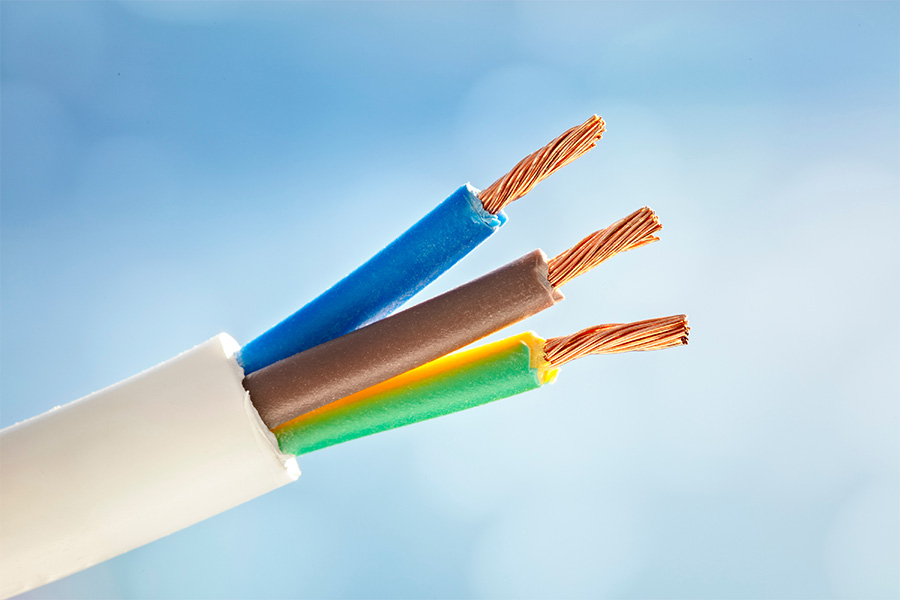
A cross section of a cable showing the blue neutral wire, brown live wire and green earth wire.

Electrical wiring colours might seem confusing at first, especially if you live in an older property where the wiring doesn’t match modern standards. But understanding what each wire colour means can help you stay safer around your home’s electrics and spot when something may need professional attention.

In this guide, we’ll explain the current UK wiring colours, how they compare to older wiring systems, and what each wire actually does. We’ll also cover when the wiring colours changed and why it’s important to approach electrical work carefully if you come across old or mixed wiring.


Table of contents

  1. What are the current UK wiring colours?
  2. Old wiring colours in the UK
  3. Old vs. new wiring in the UK: What’s changed?
  4. Is old wiring covered by home electrical cover?
  5. Explore reliable cover for your home’s electrics

What are the current UK wiring colours?

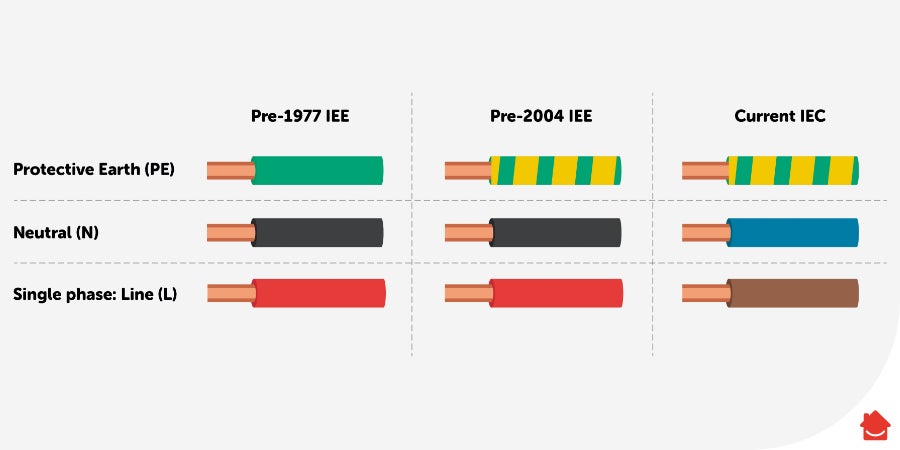
Diagram demonstrating the difference between pre-2004 wiring and post-2004 wiring.

The UK now uses a standardised wiring colour system designed to make electrical installations safer and easier to understand.

The current UK wiring colours are: 

  • Live wire: Brown 
  • Neutral wire: Blue 
  • Earth wire: Green and yellow stripes

These colours are used in all modern UK homes and electrical installations.

What does the live wire do?

The live wire carries electricity from the power source to a switch, socket or appliance.

Because it carries current, the live wire is the most dangerous wire to touch if the power is still on. In current UK wiring colours, the live wire is brown.

What does the neutral wire do?

The neutral wire carries electricity back from the appliance to the power source, completing the circuit.

Neutral wires also help distribute electrical loads evenly across circuits. In modern UK wiring, the neutral wire is blue.

What does the earth wire do?

The earth wire is an important safety feature within an electrical system.

Its job is to protect against electric shock by providing a safe path for electricity to travel to the ground if there’s a fault. This helps reduce the risk of injury and damage.

In current UK wiring colours, the earth wire is green and yellow in a striped pattern or can be a bare copper wire with a green and yellow striped sleeve.

Bonus: Strapper cables

Strapper cables are found mostly in hallways, stairwells, and large rooms where controlling a single light from multiple access points is necessary. They would also be used for extractor fans or controllers.

While older strapper cables use red, yellow and blue cable colours to connect an outlet to different switches, modern standard cables often use brown, grey and black for the strapper wires.

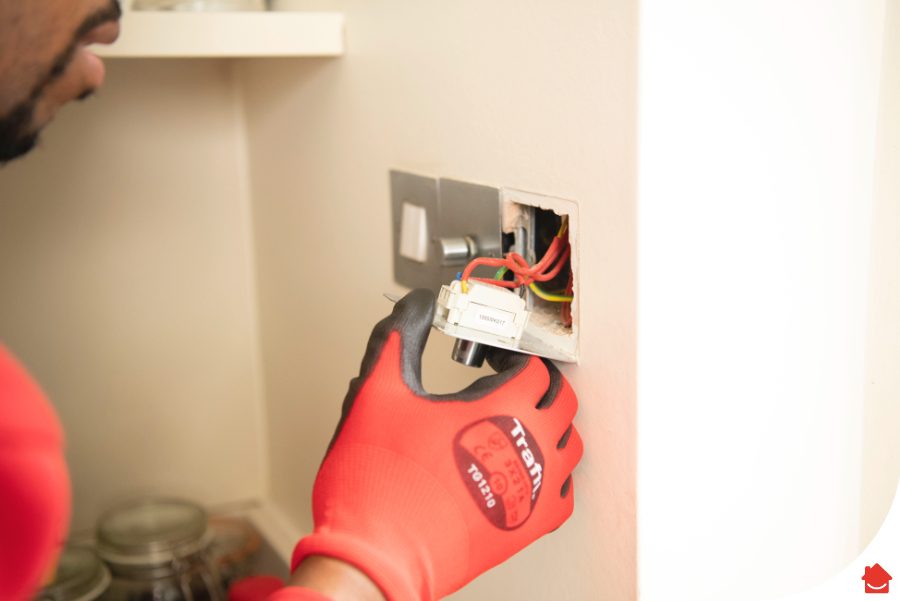
If you’re a DIYer and you come across a strapper wire while you’re doing any basic electrical work, it’s best to call a qualified electrician to finish the job. They can be tricky to get right if you’re not properly trained.

Old wiring colours in the UK

Before the current standards were introduced, the UK used a different wiring colour system.

The old UK wiring colours were:

  • Live wire: Red
  • Neutral wire: Black
  • Earth wire: Green and yellow

In very old systems installed before 1977, the earth wire may be entirely green rather than green and yellow striped.

Because of this, some homes in the UK may still contain old wiring colours, newer wiring colours, or even a mixture of both.

When did the UK wiring colours change?

The UK wiring colours changed in 2004 under updated wiring regulations.

The change was introduced to align UK electrical standards with European regulations and help reduce confusion during electrical work. Standardising wiring colours also improved safety for electricians and homeowners.

Because some older homes still contain previous wiring systems, electricians today can often come across both old and new wire colours in the same property.

Old vs. new wiring in the UK: What’s changed?

Wire function

Old colours (pre-2004)

New colours (2004 onwards)

Live

Red

Brown

Neutral

Black

Blue

Earth

Green and yellow stripes (or green pre-1977)

Green and yellow stripes

If you’re unsure about the wiring in your home, think you may have outdated electrics, or suspect faulty wiring, it’s always safest to contact a qualified electrician. Electrical work can be dangerous if carried out incorrectly, particularly in homes with mixed wiring systems.

Is old wiring covered by home electrical cover?

If it was installed correctly at the time of installation, even older wiring is covered by HomeServe Electrics cover, giving you peace of mind even in older homes. All home emergency cover policies are different, so be sure to check your policy details when you’re comparing providers.

Explore reliable cover for your home’s electrics

Electrical problems can happen without warning, whether it’s faulty wiring, broken sockets or unexpected electrical faults.

With HomeServe’s Electrics cover, you’ll have access to qualified electricians who can help get things back up and running quickly—and most importantly, safely. So, whether you’re dealing with older wiring or unexpected electrical issues, you can count on us to be there when you need help most.

Share this post

About the author

After an early and varied career, including serving in the Falklands and also working as an active firefighter, Sam began his journey as an electrician in the 1990s as an apprentice with Bowdens Electrical contractors.

Since becoming qualified in 1995, Sam has worked on a broad range of electrical repairs and installations, including caravan site supplies, wiring of new build houses, and response to out of hours calls. His experience extends to both domestic and commercial projects, including working on electrical installations in large businesses such as shopping centres, residential homes, street infrastructure and many others.

Since joining HomeServe in 2018, his role has changed from being ‘hands on’ to a more knowledge and research based position within the Technical Governance Team, ensuring the business operates in a way that meets, or surpasses, industry regulations and standards.

“I thoroughly enjoy working with HomeServe and almost every day brings a new challenge.”

He loves spending time with his bulldog Bert, sailing his yacht or walking in the countryside.

Institute of Engineering & Technology-technician member, Institute of Engineering & Technology member. Solar PV Systems installation & inspection, City & Guilds 2382, City & Guilds 2330, City & Guilds 2391, City & Guilds 2377, City & Guilds 2377-1, Tetra Working at Height, Tetra Restraint Equipment Inspection, Tetra Electrical Equipment Inspection, LCL Electric Vehicle Charging Systems, I.O.S.H. Management

Years qualified

Since 1995
Read more

Share this post

About the author

After an early and varied career, including serving in the Falklands and also working as an active firefighter, Sam began his journey as an electrician in the 1990s as an apprentice with Bowdens Electrical contractors.

Since becoming qualified in 1995, Sam has worked on a broad range of electrical repairs and installations, including caravan site supplies, wiring of new build houses, and response to out of hours calls. His experience extends to both domestic and commercial projects, including working on electrical installations in large businesses such as shopping centres, residential homes, street infrastructure and many others.

Since joining HomeServe in 2018, his role has changed from being ‘hands on’ to a more knowledge and research based position within the Technical Governance Team, ensuring the business operates in a way that meets, or surpasses, industry regulations and standards.

“I thoroughly enjoy working with HomeServe and almost every day brings a new challenge.”

He loves spending time with his bulldog Bert, sailing his yacht or walking in the countryside.

Institute of Engineering & Technology-technician member, Institute of Engineering & Technology member. Solar PV Systems installation & inspection, City & Guilds 2382, City & Guilds 2330, City & Guilds 2391, City & Guilds 2377, City & Guilds 2377-1, Tetra Working at Height, Tetra Restraint Equipment Inspection, Tetra Electrical Equipment Inspection, LCL Electric Vehicle Charging Systems, I.O.S.H. Management

Years qualified

Since 1995
Read more

Still looking for more help & advice?

Our help & advice articles cover Plumbing, Home heating, Electrical, Energy-saving and Home maintenance.
View all articles