
5 reasons why your thermostat isn’t working

Settings being changed on a wall mounted thermostat because it's not working.
Your thermostat is essential to keeping your home warm and comfortable, so it’s one of the first things you look at when it starts to get cold. If you’ve noticed the chill and your thermostat is not working, keep reading to find out how to fix it and when to call a professional.

Table of contents

  1. 1. Your thermostat isn’t turning on or is blank
  2. 2. The thermostat is displaying the wrong temperature
  3. 3. The thermostat isn’t communicating with your boiler
  4. 4. You can’t change the temperature setting on your thermostat
  5. 5. The heating isn't reaching your thermostat's set temperature
  6. When should you replace your thermostat?
  7. Boiler and heating cover you can count on

Top tip: Is your thermostat the problem or is it your boiler? You might be quick to assume the thermostat is the issue but before you start troubleshooting, check your boiler display for fault codes to make sure it’s running properly. If it is, you can now focus on fixing the thermostat without any doubts.

1. Your thermostat isn’t turning on or is blank

If your thermostat display is completely blank and it won't turn it on, you’re probably looking at a power issue. Here’s how to fix it:
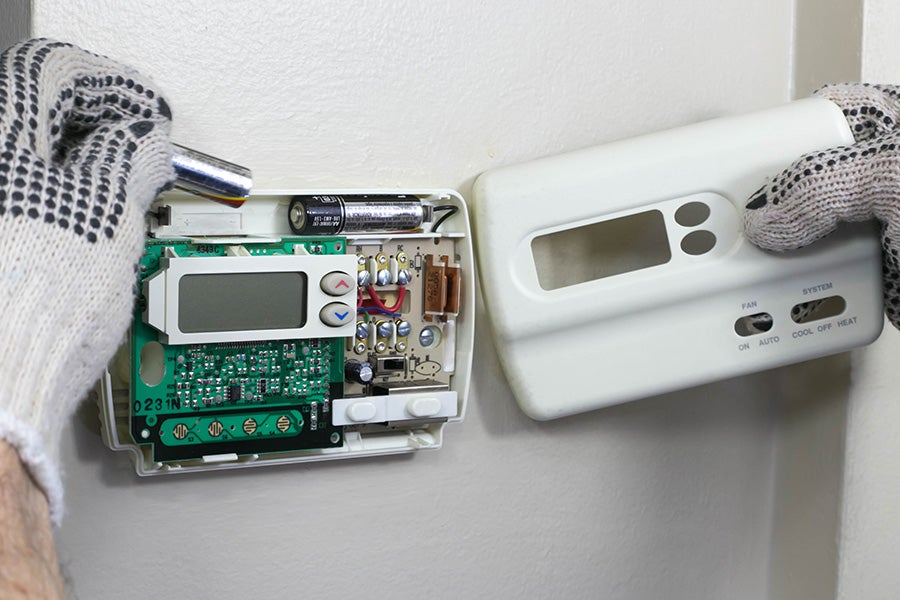
Change the batteries in your thermostat

Batteries being replaced in a wireless thermostat.

If you have a wireless smart thermostat, your batteries may have run out. Just change the batteries or recharge them if you can, to get your thermostat up and running again. Most people ignore their thermostat for most of the year, which is why a simple fix like this can catch you off guard.
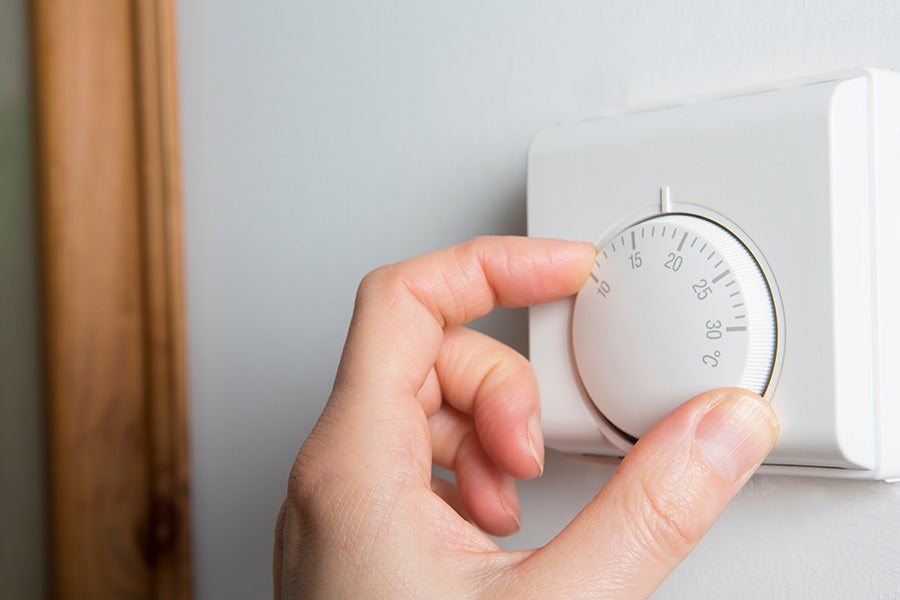
Wired thermostat? Check your boiler

Temperature being changed on a wired thermostat.

A problem with your power supply can lead to your wired thermostat not working, but it could also be a boiler fault.

First, check your thermostat for any operational lights and then check your boiler control panel for faults. If you have a boiler fault, check your manual to learn more about what to do. You may have to call a heating engineer.

If the thermostat or boiler is non-responsive, then you may have a power issue.

Check your fuse box to see if any circuits have tripped. If they have, try flipping the switch back up to get your thermostat working again.

If the switch on the fuse box doesn’t stay up or the circuit keeps tripping, contact a qualified electrician.

2. The thermostat is displaying the wrong temperature

If it’s feeling chilly in the living room, but your thermostat is saying it’s 20 degrees, then there could be a problem with the temperature sensor. There could be several reasons for this, but the most common are:

  • Dirt and dust build up: A dirty temperature sensor isn’t very good at doing its job. If you have a wireless thermostat, you can fix this by carefully removing the outer cover and gently cleaning the inside of the thermostat with compressed air or a soft brush. All thermostats are different, so consult the manual and, if there isn’t an obvious way to clean the sensor or you have a wired thermostat, don’t attempt it.
  • Low batteries: Having low power generally makes a thermostat less reliable, so make sure you have some fresh batteries on hand.
  • Location of the thermostat: It might just be that your thermostat is placed in a room that’s naturally warmer than other rooms in the house. Try moving the device around to a colder room (if it’s wireless) and checking if the heating kicks in.

Top tip: For the best performance, room thermostats should be placed in the coldest room in the house.

If the sensor is the problem, it may need to be replaced entirely, or you’ll need to replace your thermostat.
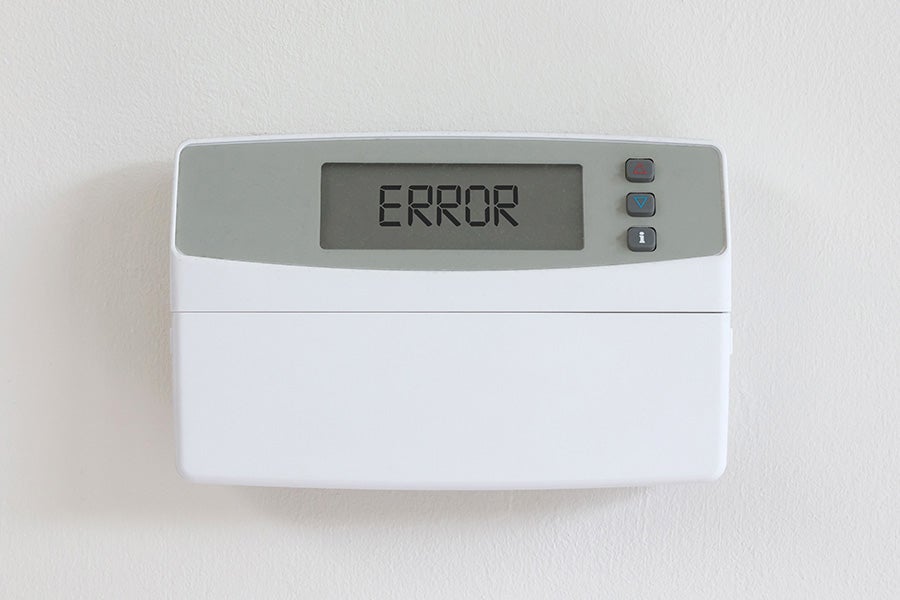
3. The thermostat isn’t communicating with your boiler

A thermostat not working and displaying and error message.

Thermostats talk to boilers in all sorts of ways, but they can often be boiled down into sending an electrical (wired thermostat) or wireless signal to the boiler’s receiver.

If your boiler isn’t showing any fault codes and looks to be working, it might be that something is interrupting the signal between the thermostat and the boiler.

Here’s what to look out for:

  • Faulty wiring: A wired thermostat connects directly to the boiler, so if there’s an issue it’s likely to be with the wiring. You will need a qualified electrician to check this for you.
  • Low battery: Checking the battery is a common theme of this guide! It’s often the simplest way to fix a thermostat problem and can be easily missed.
  • Thermostat location: Above we gave some tips on the best location for your thermostat, but here’s another one to add to the list – make sure your wireless thermostat isn’t too far away from your boiler. Just like with your WI-FI router and your phone, the farther the devices are from each other, the weaker the signal will be.
  • Interrupted connection: Thermostats can lose connection with the boiler if the boiler switches off for an extended period, like in a power cut for instance. Check the connection instructions on the manual if you think this might be the problem.
  • Faulty thermostat receiver: If everything else looks good but your thermostat and boiler still aren't getting along, there could be a problem with the thermostat receiver. If this part has a fault or is worn out, it will need to be repaired or replaced. Not a job for an avid DIY-er. Call a professional instead.

4. You can’t change the temperature setting on your thermostat

Temperature setting not responding to your controls? This could be because of the following:

  • The child lock is on: Some thermostats have a child lock that may have accidentally been switched on. There might be a symbol on your display to let you know the child lock is on but if you want to be sure then look at your manual and check if your thermostat has a child lock (and how to turn it off).
  • Battery issues: You know what to do by now – if the batteries are low, replace them with fresh ones.
  • Dirt and dust build up: This can make a thermostat less responsive, so give it a wipe over with a clean cloth and clean the surrounding area if needed.
  • App controls: If you have a smart thermostat with a companion app, there’s could be a setting on the app that’s preventing manual changes to the temperature. Check the settings and try again.

5. The heating isn't reaching your thermostat's set temperature

You’ve got the heating on, but it never seems warm enough. Sound familiar? Here’s what could be happening:
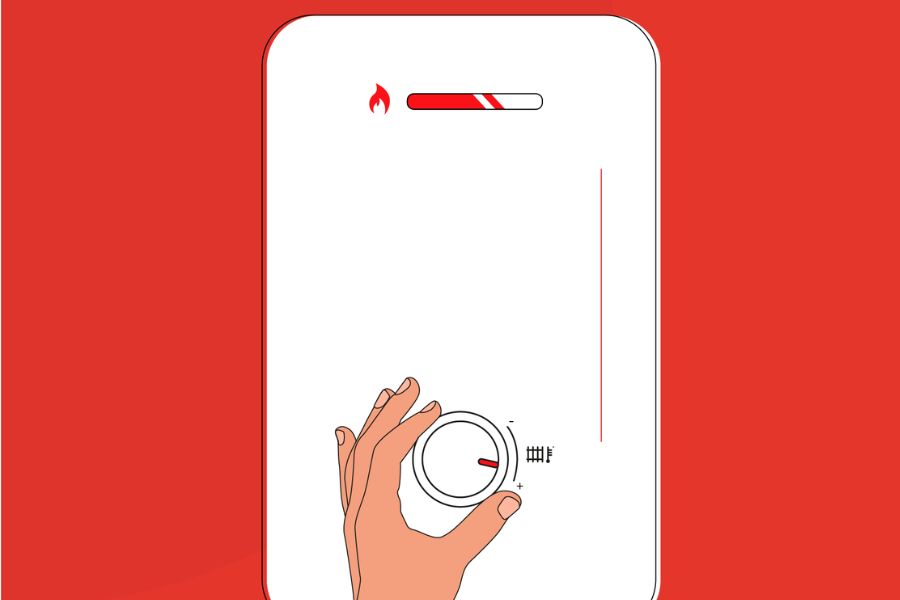
Low boiler flow temperature setting

Graphic of a combi boiler with its boiler flow temperature dial being turned down

Boiler flow settings control the temperature of the water that goes into your radiators. Setting it lower can help save energy, but it will take a little longer to reach your target temp. You can change the flow temperature on your boiler’s control panel.

Settings that reduce wear and tear

Most thermostats have a feature that stops your heating from kicking in every time the temperature drops below target.

For instance, if the thermostat is set to 18 degrees and the temperature of the room drops to 17.9, the boiler wouldn’t turn back on immediately because the constant on and off causes wear and tear. Instead, the boiler would turn on again at a lower temperature (i.e. 17.5), to help prolong the life of the boiler.

If you want your room to be warmer and more consistent, try turning up the thermostat by half a degree.
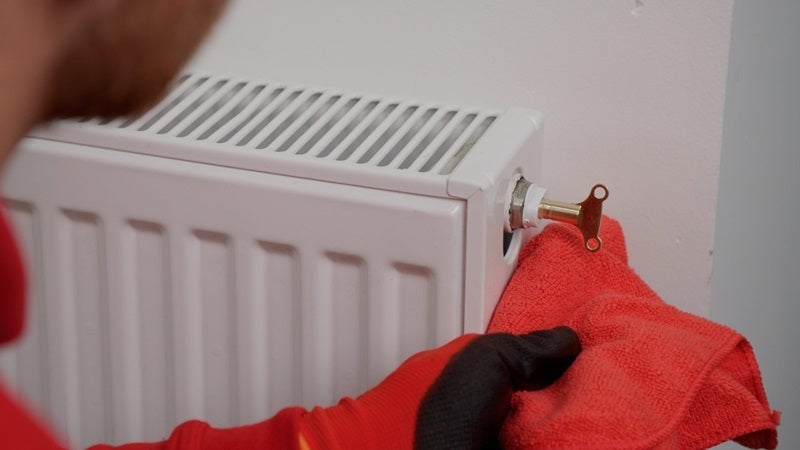
Your radiators need bleeding

HomeServe engineer bleeding a radiator with a radiator key

Cold spots at the top of your radiator are usually due to a build-up of trapped air, which makes your heating less efficient. Bleeding your radiators will help you reach your target temperature quicker.

When should you replace your thermostat?

As a rule of thumb, you should think about replacing your thermostat if it stops meeting your needs, is causing inconsistent heating in your home, or has consistent faults that can’t be repaired. Here are some potential scenarios:

  • Unsupported software: Smart thermostats receive ongoing support and software updates from the manufacturer, but over time they can stop supporting these devices, meaning your thermostat will lose some of its functionality.
  • Incorrect temperature readings: If you’ve followed the steps above and are still getting incorrect temperature readings, it might be time to call a heating engineer. If the thermostat is the problem, they may suggest a replacement.
  • Outdated devices: When older, wired thermostats break down they’re often replaced rather than repaired, so it may be time to upgrade to a smart thermostat.

Boiler and heating cover you can count on

Whether your thermostat stops working or your boiler breaks down, HomeServe Boiler and Central Heating cover has got your back. With home emergency cover, you’ll have peace of mind knowing that a Gas Safe registered engineer is just a phone call (or a few clicks) away.

Need some help now? Check out Ding, our dedicated repairs service.

Share this post

About the author

Chris became a fully qualified Gas Engineer in 2009 and has been with HomeServe since 2016. Chris hung up his tool bag in 2018 to concentrate on ways to use technology to help Customers.

He currently heads up the Self Fix team who are able to get Customers back up and running over the phone without the need for an Engineer.

He is kept busy looking after his two daughters and is a lover of all things CrossFit, Yoga and Ice Baths!

“I chose to work at HomeServe after running a small business. I wanted to be able to help people on a greater scale and HomeServe has helped me achieve that.”

Gas Safe registered, CCN1, CPA1, CENWAT, CKR1, HTR1, NVQ Level 3 Plumbing & Heating

Years qualified

Since 2009
Read more

Share this post

About the author

Chris became a fully qualified Gas Engineer in 2009 and has been with HomeServe since 2016. Chris hung up his tool bag in 2018 to concentrate on ways to use technology to help Customers.

He currently heads up the Self Fix team who are able to get Customers back up and running over the phone without the need for an Engineer.

He is kept busy looking after his two daughters and is a lover of all things CrossFit, Yoga and Ice Baths!

“I chose to work at HomeServe after running a small business. I wanted to be able to help people on a greater scale and HomeServe has helped me achieve that.”

Gas Safe registered, CCN1, CPA1, CENWAT, CKR1, HTR1, NVQ Level 3 Plumbing & Heating

Years qualified

Since 2009
Read more

Still looking for more help & advice?

Our help & advice articles cover Plumbing, Home heating, Electrical, Energy-saving and Home maintenance.
View all articles